
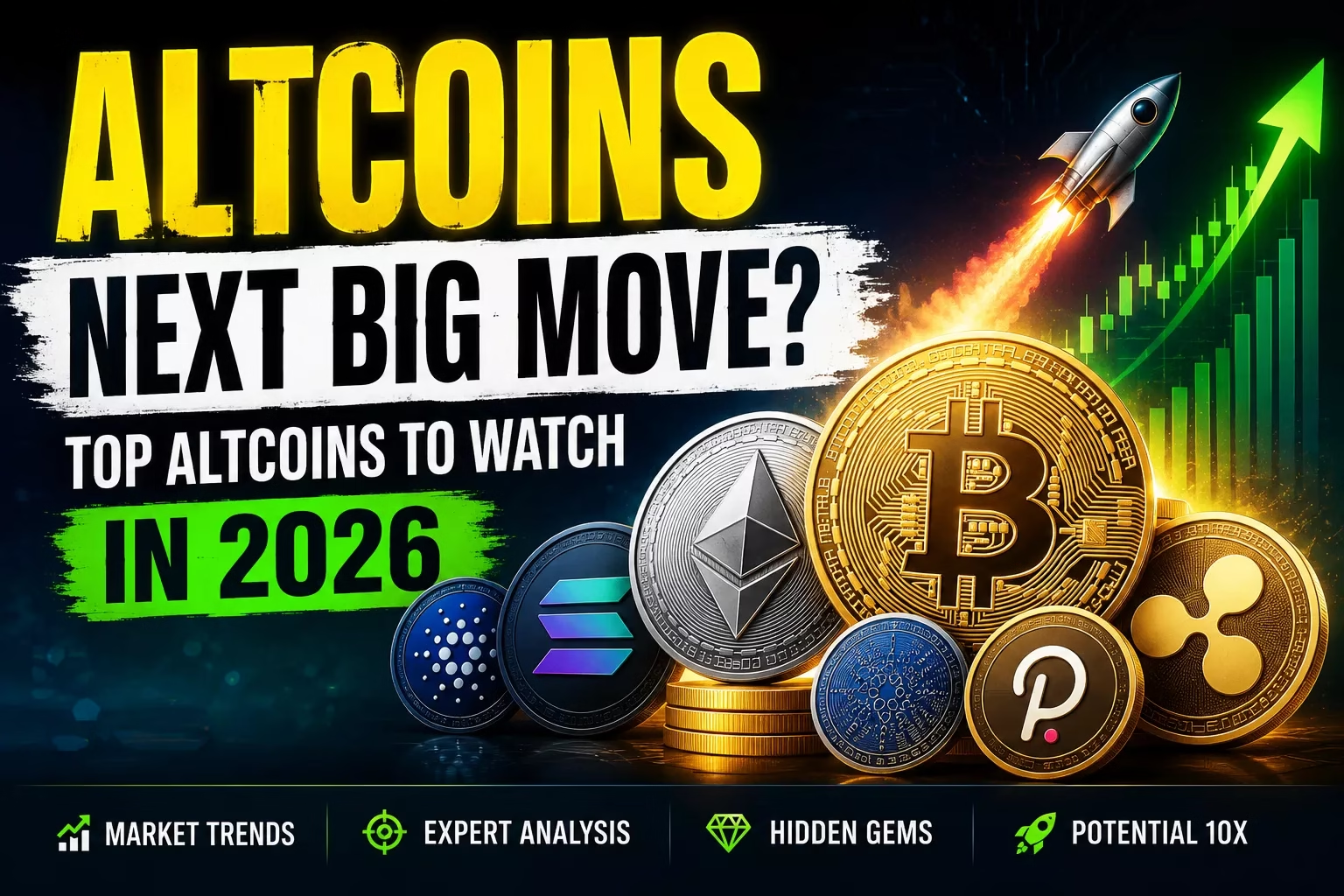
People often feel a mix of excitement and worry when they hear about altcoins. Bitcoin gets a lot of attention, but what about all the other digital currencies? Are they still relevant, and can they offer real value in the middle of 2026?
In this article, readers will understand:
* What happened
* Why it matters
* Financial and economic impact
* Risks and opportunities
* What to watch next
What Exactly Are Altcoins, and How Did We Get Here?
Altcoins are simply all cryptocurrencies other than Bitcoin. They represent a huge part of the digital asset world, often trying to improve on Bitcoin’s original design or serve different purposes. From their beginnings, altcoins have aimed to offer new features like faster transactions, smarter contracts, or specialized applications for things like gaming and finance.
When Bitcoin first launched, it was the only game in town. Soon after, developers started creating new coins, hoping to build on Bitcoin’s ideas or fix its perceived shortcomings. These “alternative coins,” or altcoins, quickly grew into a vast and diverse ecosystem. Early altcoins like Litecoin focused on faster transaction times, while later ones like Ethereum introduced “smart contracts” that changed how digital agreements could work. This constant innovation pushed the crypto space forward, leading to thousands of different altcoins each with its own goals and community.
What Are the Latest Developments in the Altcoin World?
The altcoin world in mid-2026 is seeing a shift towards practical use and institutional interest, moving past pure speculation. We are observing significant advancements in regulatory clarity, the rise of real-world asset (RWA) tokenization, and strong growth in Decentralized Finance (DeFi) and Layer 2 solutions.
Several promising altcoins are attracting attention in June 2026, including Cardano (ADA), Solana (SOL), and Polkadot (DOT), due to their strong technology and long-term potential. Cardano focuses on energy-efficient Proof-of-Stake and smart contract development, Solana offers ultra-fast transactions for high-demand applications, and Polkadot enables blockchain interoperability. Newer projects like Base, Blast, ZetaChain, Saga, and Avail are also gaining traction because of their focus on scaling, cross-chain connectivity, and making blockchain applications easier to use.
The global cryptocurrency market capitalization stands at about $2.2 trillion as of mid-2026, with altcoins accounting for nearly $1.06 trillion. This shows a growing interest in diversified assets beyond Bitcoin. Stablecoins, which are digital currencies pegged to traditional assets like the US dollar, reached an all-time high of $310 billion by the end of 2025, playing a crucial role as a primary settlement layer in the crypto ecosystem.
How Are Regulations Shaping the Altcoin Landscape?
Regulations are becoming much clearer for cryptocurrencies in 2026, with many countries moving to create specific laws. This shift helps the market mature and brings more confidence to investors and businesses.
Globally, 68 countries have now either passed or proposed cryptocurrency-specific laws, a significant jump from 42 in 2024. The European Union’s MiCA (Markets in Crypto-Assets) framework has become a leading model, with 14 non-EU countries adopting similar rules. In the US, a major development is the GENIUS Act, signed in July 2025, which provides a federal framework for stablecoins. This law requires stablecoins to be fully backed 1:1 by high-quality liquid assets and prohibits issuers from paying interest on them. The US Securities and Exchange Commission (SEC) and Commodity Futures Trading Commission (CFTC) have also clarified their roles, with a joint statement in March 2026 classifying 16 major tokens, including Bitcoin, Ethereum, Solana, and XRP, as digital commodities under CFTC oversight. These changes are reducing regulatory uncertainty and making it easier for traditional financial institutions to engage with digital assets.
What is the Financial Impact of Altcoins Today?
Altcoins are increasingly impacting individual portfolios and the broader financial system by offering new investment avenues and ways to earn. However, this comes with its own set of risks.
Many altcoins remain significantly below their all-time highs, with the five largest (Ether, BNB, XRP, Solana, and TRON) still trading about 60% down on average. Despite this, over 740 million people worldwide now hold crypto, and many are adding to their positions. The Decentralized Finance (DeFi) market is a big part of this, projected to grow from $238.54 billion in 2026 to $770.56 billion by 2031, with a compound annual growth rate (CAGR) of 26.43%. This growth is driven by things like regulated access and the tokenization of real-world assets.
For example, imagine someone invested $1,000 in a promising altcoin with a focus on real-world asset tokenization at the beginning of 2026. If that project saw strong institutional adoption and its tokenized real estate market grew as projected (estimated at $78 billion in 2026), that initial investment could see significant returns, far outpacing traditional savings. However, if they chose a purely speculative altcoin with no real utility, their investment could easily lose most of its value, similar to many speculative projects that have seen 70% declines since 2025. This highlights the selective nature of the current altcoin market.
How Are Altcoins Affecting the Broader Economy?
Altcoins are increasingly shaping the global economy by fostering new industries, driving technological innovation, and attracting significant capital, blurring the lines between traditional finance and decentralized systems.
The integration of blockchain technology, especially through altcoins, is enabling 24/7 global trading and more efficient cross-border transactions. The New York Stock Exchange, for instance, has announced plans to embrace 24/7 tokenized trading. This means that financial markets can operate continuously, potentially boosting global commerce and investment flows. Tokenized real-world assets (RWAs) are a prime example, expanding from roughly $5 billion at the start of 2025 to over $30 billion by mid-2026. This trend allows for fractional ownership of assets like real estate or art, making investments more accessible to a wider range of people. The growth of Decentralized Finance (DeFi) also promotes financial inclusion by offering lending, borrowing, and earning opportunities to individuals who might not meet traditional banking criteria. Furthermore, industries like AI and gaming are increasingly using blockchain, creating new job markets and pushing for more advanced computational infrastructure, as seen with projects like Render Network.
What Has the Market Reaction Been to Altcoin Trends?
The market reaction to altcoin trends in mid-2026 is one of increasing selectivity, with capital flowing towards projects that demonstrate real utility and integration with traditional finance, rather than speculative hype.
Bitcoin’s dominance remains high, around 58%, showing investor caution. However, this doesn’t mean altcoins are out of favor. Instead, it indicates a shift from a broad “altcoin season” to a more “stock-picker’s market” where investors carefully choose projects with strong fundamentals. For instance, infrastructure projects tied to institutional demand, such as RWA tokenization and on-chain private credit, have seen continuous growth. Tokenized real-world assets have grown from $5 billion in early 2025 to over $30 billion by mid-2026, with on-chain private credit offering attractive yields of 8% to 12%. This suggests that traditional financial institutions are now actively exploring and investing in blockchain-based solutions. The strong performance of decentralized perpetual exchanges like Hyperliquid, which has seen ETF products launched around it, further highlights this shift towards utility and traditional finance integration.
How Are Investors Approaching Altcoins Right Now?
Investors are approaching altcoins with a more cautious and selective mindset in mid-2026, prioritizing projects with tangible utility, strong fundamentals, and clear integration with traditional finance over purely speculative ventures.
The current crypto market, in June 2026, is described as being in a state of “extreme fear,” with the Fear and Greed Index at 13. Bitcoin is consolidating around $60,000, and Ethereum has shed 29% in the first quarter of 2026 alone, with altcoins generally struggling. This environment makes investors more discerning. Experts like Eric Wade divide the altcoin market into three tiers: institutional infrastructure (like RWA tokenization and on-chain private credit), speculative tokens with no revenue, and community-driven projects that continue building. Investors are increasingly favoring the first and third tiers, focusing on projects that solve real problems. For instance, Hyperliquid, a decentralized perpetuals exchange, has stood out due to its revenue generation, buybacks, and burns. Solana is also a focus for its speed, low fees, and applications in memes, RWAs, stablecoins, and consumer apps. The market is moving towards rewarding projects that generate real revenue and attract users.
If you’re an investor, it’s not enough to just hope for a broad altcoin rally. Instead, you need to be like a stock-picker, doing your homework on each project. This means looking beyond the hype and focusing on the underlying technology, use cases, and team behind the project. You can learn more about finding potential altcoins in the current market environment by checking out resources that discuss which new altcoins are poised for a surge in 2026, like this article: Beyond Bitcoin: Are New Altcoins Poised for a 2026 Surge?
What is the Consumer Perspective on Altcoins?
Consumers in mid-2026 are increasingly adopting altcoins and blockchain technology for practical uses beyond just speculation, driven by improvements in user experience and the integration of digital assets into everyday applications.
Public interest has shifted from speculative trading to functional applications of NFTs, with searches for “NFT utility” and “gaming NFTs” increasing by 52% from 2025-2026. This shows that people are looking for real value and use cases. Things like gaming NFTs that offer real in-game functionality, rather than just being speculative collectibles, are gaining traction. Also, decentralized finance (DeFi) is becoming more accessible with mobile-first applications, making it easier for users in emerging markets to participate in lending, borrowing, and earning without needing traditional banks. The user experience for NFTs has also improved significantly, with many platforms now built on low-fee blockchains and offering seamless onboarding that feels more like using a regular website or app. This shift means that ordinary people are finding more straightforward ways to interact with altcoins and blockchain technology in their daily lives, whether it’s for digital ownership, payments, or gaming.
What Are the Risks and Opportunities with Altcoins?
Investing in altcoins in mid-2026 comes with significant risks like high volatility and potential project failures, but also opportunities in utility-driven sectors such as real-world asset tokenization, AI integration, and improved Layer 2 scaling solutions.
What are the main risks for altcoin investors?
The main risks for altcoin investors include extreme price volatility, the potential for many projects to fail due to weak fundamentals, and ongoing regulatory uncertainties in some regions. Many altcoins and smaller projects have struggled to show sustainable utility, leading to a possible consolidation around major assets like Bitcoin and Ethereum. Historically, over 70% of altcoins have failed, making diversification crucial. Charles Hoskinson, a co-founder of Cardano, has warned of a wave of ecosystem failures in the second half of 2026. There are also risks like hacking, government bans, or a prolonged bear market.
Where do the biggest opportunities lie for altcoin investors?
The biggest opportunities for altcoin investors are found in projects focusing on tangible utility and integration with traditional finance, especially in areas like real-world asset (RWA) tokenization, AI x crypto, Layer 2 scaling solutions, and stablecoins. Tokenized real-world assets have seen massive growth, from $5 billion in early 2025 to over $30 billion by mid-2026, offering yields of 8% to 12% on private credit. The intersection of AI and crypto is also a compelling opportunity, with autonomous agents suited to blockchain infrastructure. Layer 2 solutions, which help blockchains like Ethereum handle more transactions faster and cheaper, are crucial for Web3 adoption. Projects like Arbitrum and Base are leading the charge here. Furthermore, the ongoing maturation of DeFi, with its focus on compliant access and institutional involvement, presents strong growth potential.
How Do Current Altcoin Trends Compare to Past Cycles?
The current altcoin market in mid-2026 differs significantly from past cycles, moving away from broad, speculative rallies towards a more discerning environment that prioritizes utility, institutional integration, and clear problem-solving.
In previous bull markets, a rising tide often lifted all boats, meaning many altcoins, regardless of their fundamentals, would see price increases. However, the current cycle is not a broad “altseason” where every altcoin will rally. Instead, Bitcoin still dominates 56-58% of the market. A true altcoin season would likely require Bitcoin’s dominance to drop below 55%. The market is now rewarding projects that generate real revenue, attract users, and solve tangible problems. This is a stark contrast to earlier periods when hype and speculative narratives often drove prices, even for projects with weak foundations. For example, many speculative profile-picture NFT projects from 2021 have lost significant value, while NFTs focused on utility in gaming, enterprise, and finance are showing sustained growth. This shift means investors need to be more selective than ever, focusing on long-term sustainability rather than quick gains from speculative assets.
What is the Future Outlook for Altcoins?
The future outlook for altcoins points towards a continued focus on real-world utility, strong regulatory frameworks, and integration with traditional financial systems, rather than widespread speculative rallies.
Experts predict a “selective recovery” for altcoins, not a broad bull market that lifts all tokens. Capital will likely favor projects demonstrating real revenue and utility, such as those in tokenized real-world assets (RWAs), stablecoins, AI infrastructure, and Layer 2 solutions. There’s an expectation that an equities correction in the second half of 2026 could redirect liquidity towards digital assets, initially benefiting Bitcoin, then large-cap altcoins like Ethereum and Solana, before potentially moving into more speculative assets. By 2030, some predictions suggest that nearly 10% of all global financial assets (treasuries, money market funds, equities, and private credit) could exist in tokenized form. This indicates a profound shift towards a more integrated and tokenized financial future, where altcoins play a crucial role as foundational infrastructure.
What Does Expert Analysis Say About Altcoins?
Expert analysis in mid-2026 suggests that the altcoin market is maturing, with a strong emphasis on practical applications, regulatory compliance, and a clear differentiation between valuable projects and those driven purely by speculation.
Eric Wade, editor of the Crypto Capital newsletter, divides the market into three tiers: institutional infrastructure (like RWA tokenization and on-chain private credit), speculative tokens with no revenue, and community-driven projects. He believes the “winners” will be found in the first and third categories. Bart Smith, CEO of Avalanche Treasury Co., emphasizes asking: “What’s the purpose? What problem does this solve?” He believes projects that can answer these questions will recover and appreciate. Chandler Fang, founder and CEO of t54, sees the intersection of crypto and AI as a compelling opportunity, especially for autonomous agents. Analysts also point to the EU’s MiCA framework as a global template for regulation, which is bringing clearer oversight and attracting institutional capital into compliant channels. This collective expert sentiment highlights a market that is becoming less forgiving of projects without genuine utility and more supportive of those that offer real value and adhere to evolving regulatory standards.
What Practical Steps Can You Take Now?
To navigate the current altcoin market effectively, focus on thorough research, diversify your investments, prioritize projects with clear utility and strong teams, and stay informed about regulatory changes.
Here are some practical takeaways:
* **Do Your Own Research (DYOR):** Don’t just follow the hype. Look into a project’s whitepaper, its team, its technology, and its real-world use cases. Ask yourself what problem the altcoin is trying to solve.
* **Diversify Your Portfolio:** Don’t put all your eggs in one basket. Instead of investing heavily in just one altcoin, spread your investments across several promising projects. This can help manage risk in a volatile market.
* **Focus on Utility:** The market is rewarding projects with real-world applications. Look for altcoins involved in areas like real-world asset (RWA) tokenization, decentralized finance (DeFi), artificial intelligence (AI) integration, and Layer 2 scaling solutions.
* **Understand the Technology:** Familiarize yourself with how different blockchain technologies work. For instance, understanding Layer 2 solutions can help you identify projects that are genuinely addressing scalability issues. You can find out more about Layer 2 solutions and their importance on Financewithxpert.
* **Stay Updated on Regulations:** The regulatory landscape is constantly changing. Keep an eye on news about new laws and guidelines, especially in major economic blocs like the EU and the US, as these can significantly impact the market.
* **Consider Risk-to-Reward:** Evaluate the potential upside against the potential downside. Some established altcoins like Cardano, Solana, and Polkadot offer strong fundamentals, while newer projects like LiquidChain or Bitcoin Hyper might offer higher risk but also higher potential rewards.
* **Be Patient:** Crypto markets are known for their volatility. A selective recovery means that gains might not be immediate or universal. Long-term thinking often yields better results than chasing short-term pumps.
Key Takeaways
In mid-2026, the altcoin market is moving away from speculative excitement towards a focus on practical applications and strong fundamentals. Regulations are becoming clearer, attracting more institutional interest, especially in areas like real-world asset tokenization and stablecoins. While there are still risks from market volatility and project failures, significant opportunities exist for investors who carefully select projects with genuine utility, robust technology, and clear problem-solving capabilities. It’s a market that rewards diligent research and a long-term perspective.
Final Conclusion
The altcoin landscape in mid-2026 is undergoing a significant transformation. It’s no longer just about the next big pump, but about which projects can demonstrate real value, integrate with existing financial systems, and adapt to an increasingly regulated environment. For those willing to do their homework and focus on utility-driven innovation, the world beyond Bitcoin offers a compelling and evolving array of opportunities.
Frequently Asked Questions About Altcoins in Mid-2026
What is the current market capitalization for altcoins in mid-2026?
As of mid-2026, the global cryptocurrency market capitalization is approximately $2.2 trillion, with altcoins contributing nearly $1.06 trillion of that total. This shows a substantial and growing portion of the crypto market dedicated to altcoins.
Are altcoins still a good investment in 2026?
Investing in altcoins in 2026 can be a good opportunity, but it requires careful selection. The market is becoming more discerning, favoring projects with real-world utility, strong fundamentals, and clear value propositions over purely speculative ones. Diversification and thorough research are key.
Which altcoin sectors are seeing the most growth in 2026?
The altcoin sectors experiencing the most significant growth in 2026 include real-world asset (RWA) tokenization, Decentralized Finance (DeFi), AI integration with blockchain, and Layer 2 scaling solutions. These areas are attracting both retail and institutional interest due to their practical applications.
How has regulation impacted altcoins in 2026?
Regulation has brought more clarity and maturity to the altcoin market in 2026. Frameworks like the EU’s MiCA and the US GENIUS Act for stablecoins are reducing uncertainty, fostering institutional adoption, and encouraging projects to build with compliance in mind. This shift helps legitimize digital assets within the broader financial system.
What role do stablecoins play in the altcoin ecosystem today?
Stablecoins are playing a critical role in the altcoin ecosystem, serving as a primary settlement layer for transactions. The stablecoin market reached an all-time high of $310 billion by the end of 2025, highlighting their importance in providing stability and facilitating liquidity within the volatile crypto space.
Why are Layer 2 solutions important for altcoins?
Layer 2 solutions are crucial for altcoins, especially for scaling networks like Ethereum, by enabling faster transactions and lower fees without compromising security. These solutions are essential for supporting wider adoption of Web3 applications, gaming, and DeFi, making blockchain technology more efficient and user-friendly.
What is the difference between this altcoin cycle and previous ones?
This altcoin cycle differs from previous ones by being more selective and utility-driven rather than a broad, speculative “altseason.” Investors are now prioritizing projects that generate real revenue, have strong user adoption, and solve tangible problems, shifting away from hype-driven narratives that dominated earlier cycles.
What are some emerging altcoin projects to watch in 2026?
Some emerging altcoin projects attracting attention in 2026 include Base, Blast, ZetaChain, Saga, and Avail, which focus on scaling and cross-chain connectivity. Established projects like Cardano, Solana, and Polkadot also remain key due to their ongoing development and strong fundamentals.
How can consumers benefit from altcoins in mid-2026?
Consumers can benefit from altcoins in mid-2026 through practical applications like owning in-game assets with gaming NFTs, participating in decentralized finance for lending and borrowing, and using mobile-first DeFi apps for easier access to financial services. The focus is on real utility and improved user experience.
What are the biggest risks for new altcoin projects?
New altcoin projects face significant risks, including intense competition, the challenge of demonstrating sustainable utility, and the potential for regulatory scrutiny. Many projects struggle to gain traction or generate revenue, leading to high failure rates. Investors should be wary of projects based purely on hype without a solid foundation.
COMMENTS