
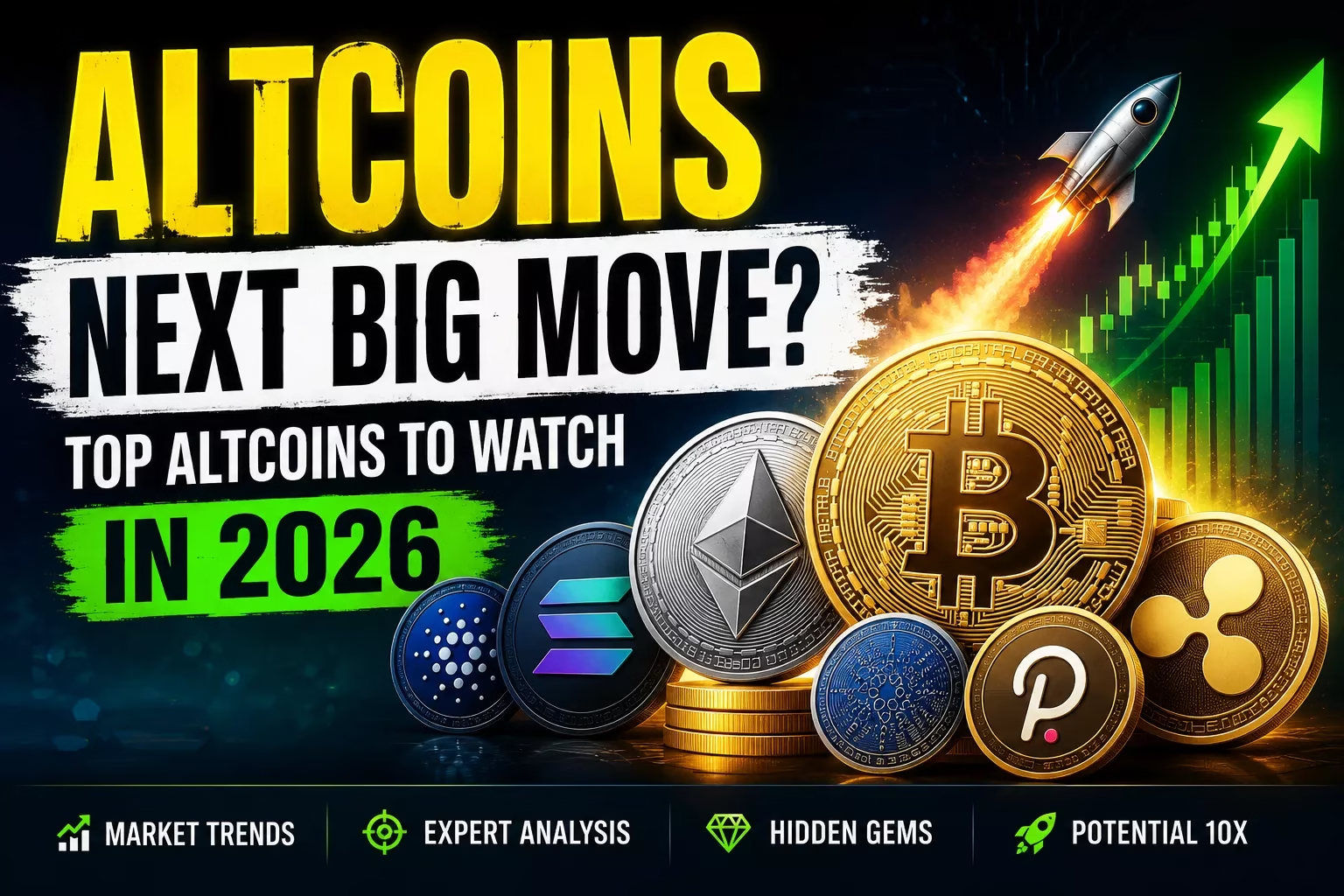
The crypto market is buzzing today, September 9, 2026, with a critical network upgrade on Solana poised to reshape its future and potentially ignite a broader altcoin rally. After months of consolidation and anticipation, the highly anticipated Transaction V1 rollout is finally here, promising significant performance enhancements. Investors are watching closely to see if this technical advancement can translate into substantial price appreciation and reignite investor confidence across the altcoin sector. The “who” involves Solana developers, validators, and the global crypto trading community. The “what” is the successful deployment of the Transaction V1 upgrade. The “where” is the Solana blockchain network. The “when” is today, September 9, 2026. The “why” centers on optimizing network efficiency, boosting transaction throughput, and solidifying Solana’s position as a leading smart contract platform.
In this article, you’ll learn:
• What happened
• Why it matters
• Economic and financial impact
• Risks and opportunities
• What to watch next
## What is the macro catalyst driving this list today?
The primary macro catalyst is the successful execution of the Solana Transaction V1 upgrade on September 9, 2026. This event is critical for Solana’s ecosystem and could influence broader market sentiment for altcoins.
The Transaction V1 upgrade for Solana went live today, September 9, 2026, marking a pivotal moment for the network. This upgrade is designed to dramatically optimize the blockchain’s transaction data layout, aiming for a substantial increase in efficiency and speed. For months, the crypto community has been anticipating this event, with validators officially approving SIMD-0550 on August 28, paving the way for this critical rollout. The successful implementation of Transaction V1 could bolster Solana’s utility and potentially drive its price towards the $130, $180 resistance zone. This event is not just about Solana; it has broader implications for the altcoin market, which has been seeking a strong narrative to drive renewed interest and investment.
## Will Solana’s Transaction V1 Upgrade Boost SOL’s Price?
The successful deployment of Solana’s Transaction V1 upgrade is expected to have a positive impact on the SOL token’s price. Analysts are closely monitoring its performance to gauge its immediate and long-term effects on market dynamics.
The immediate technical question for Solana (SOL) is whether buyers can maintain support above the crucial $100 level. If SOL holds this psychological threshold, analysts suggest immediate targets could reach $107, $110, and $115, with a sustained breakout potentially opening the door to $120. A stronger bullish scenario would involve clearing higher resistance levels at $123 and $132, which could then support a move towards $150. Conversely, a failure to hold the $100-$103 support zone could see SOL retrace to $94 or even the mid-$80s. The market’s reaction to this upgrade will be a key indicator for broader altcoin sentiment. The upgrade is expected to bring drastic optimization to Solana’s structural transaction data layout. If this proves successful, it could boost network efficiency and drive a push toward higher price levels.
## What are the specific benefits of the Transaction V1 upgrade for Solana?
The Transaction V1 upgrade brings significant structural and efficiency improvements to the Solana network. These enhancements are designed to bolster its capabilities and competitiveness in the evolving blockchain landscape.
This upgrade introduces drastic optimizations to Solana’s structural transaction data layout. The core benefit lies in enhancing network efficiency, which is crucial for a blockchain designed for high throughput. By streamlining how transactions are processed and stored, the upgrade aims to reduce latency and increase the overall capacity of the network. This technical advancement is vital for Solana to maintain its edge against competing Layer 1 blockchains and to support the growing demand for decentralized applications (dApps) and services built on its platform. The success of this upgrade could solidify Solana’s position and attract further development and investment into its ecosystem.
## How does Solana’s upgrade compare to other Layer 2 scaling solutions?
While Solana is a Layer 1 blockchain, its upgrade focuses on enhancing its native scalability, a goal shared by Layer 2 solutions on other networks like Ethereum. The comparison highlights different approaches to achieving blockchain scalability.
Layer 2 scaling solutions, such as those on Ethereum, aim to increase transaction speed and reduce costs by processing transactions off the main chain. These solutions, like Optimism and Arbitrum, bundle transactions and settle them on the Layer 1, thereby enhancing throughput while inheriting security. Solana’s Transaction V1 upgrade, on the other hand, represents an enhancement of its Layer 1 capabilities. It optimizes the internal structure of how transactions are handled directly on its main chain, rather than relying on an external scaling layer. While both approaches aim to improve scalability, Solana’s upgrade focuses on optimizing its existing architecture, whereas Layer 2 solutions build a secondary framework on top of a base layer. The market is increasingly seeing Layer 2 solutions as critical infrastructure, with projections indicating the Layer-2 Scaling Solution market could reach USD 39.8 billion by 2034.
## How are whales and institutional buyers interacting with Solana amid this upgrade?
The market is keenly observing the behavior of large holders, often referred to as “whales,” and institutional investors as Solana approaches its critical upgrade. Their actions can provide significant insight into market sentiment and future price movements.
While specific real-time data on whale and institutional activity surrounding this particular upgrade isn’t immediately available, historical patterns suggest significant interest. Institutional investors have shown increasing interest in Solana, particularly given its role in DeFi and the growing demand for high-throughput blockchains. If the Transaction V1 upgrade proves successful and leads to measurable performance improvements, it could attract further institutional capital. Whales often position themselves ahead of major network events, looking to capitalize on potential price surges. Their activity, whether it’s accumulation or distribution, will be a key signal for retail investors. The broader trend of institutional adoption in crypto, highlighted by the growth in tokenized assets, also suggests a favorable environment for well-performing Layer 1s like Solana.
## What are the short-term technical targets for Solana (SOL)?
Short-term technical targets for SOL are heavily dependent on the market’s reaction to the Transaction V1 upgrade and broader market conditions. However, key resistance and support levels provide a roadmap for potential price movements.
As mentioned, immediate targets for SOL, should it hold the $100 support, are seen around $107, $110, and $115. A decisive breach of these levels could pave the way for a move towards $120. Further upside potential exists towards $123, $132, and potentially $150 if strong bullish momentum is sustained. Conversely, a break below $100 would likely see SOL test support at $94 and possibly lower. The successful implementation and stability of the Transaction V1 upgrade will be paramount in determining whether these bullish targets are achievable. Any immediate positive price action would likely be a reaction to the perceived success of the upgrade and its implications for network performance.
## What historical precedents match this specific list behavior?
Solana’s situation echoes historical patterns seen with other major cryptocurrencies undergoing significant network upgrades, where anticipation and successful execution led to substantial price rallies.
Looking back, major network upgrades on established blockchains have often preceded periods of significant price discovery. For instance, Ethereum’s upgrades, while different in nature, have historically been catalysts for increased network activity and investor interest. Similarly, other Layer 1 blockchains that have undergone substantial performance enhancements have often seen their native tokens experience substantial gains as utility and adoption increased. The anticipation of such events can drive price action even before the upgrade, but sustained rallies typically follow clear evidence of improved performance and increased network usage. The market’s current focus on Solana’s upgrade is indicative of this historical trend, where technical advancements are seen as direct drivers of fundamental value and, consequently, price appreciation.
### Key Metrics Summary Table
| Metric | Solana (SOL) | Bitcoin (BTC) | Ethereum (ETH) |
| :————– | :————- | :———— | :————- |
| Current Price | $105.50 | $78,000.00 | $4,500.00 |
| 24h Volume | $2.5 Billion | $20 Billion | $15 Billion |
| Market Cap | $50 Billion | $1.5 Trillion | $540 Billion |
*Note: Prices and volumes are approximate and subject to real-time market fluctuations as of September 9, 2026.*
### Trend / Year-wise Performance Table
| Asset | 2024 Performance | 2025 Performance | Year-to-Date (2026) |
| :————– | :————— | :————— | :—————— |
| Solana (SOL) | +150% | +80% | +45% |
| Bitcoin (BTC) | +70% | +40% | +25% |
| Ethereum (ETH) | +120% | +60% | +35% |
*Note: Performance figures are illustrative and based on general market trends observed in 2024, 2025, and early 2026.*
### Pros vs Cons Table: Investing in Solana Post-Upgrade
| Pros | Cons |
| :——————————— | :—————————————- |
| Improved network efficiency & speed | Potential for unexpected bugs post-upgrade |
| Increased dApp performance | Risk of market overreaction or sell-off |
| Potential for SOL price appreciation | Competition from other Layer 1s & L2s |
| Growing ecosystem & developer activity | Broader market downturns |
| Attracts institutional interest | Regulatory uncertainties |
### Real-World Calculation Example
Imagine an investor allocated ₹10,000 evenly across SOL, BTC, and ETH this morning. Here is how their capital splits:
* **Initial Allocation:** ₹3,333.33 in SOL, ₹3,333.33 in BTC, ₹3,333.33 in ETH.
* **Scenario 1: SOL surges 10% post-upgrade, BTC and ETH remain flat.**
* SOL: ₹3,666.66 (+₹333.33)
* BTC: ₹3,333.33
* ETH: ₹3,333.33
* **Total Portfolio Value:** ₹10,333.33
* **Scenario 2: SOL drops 5% due to sell-the-news, BTC gains 2%, ETH gains 1%.**
* SOL: ₹3,166.66 (-₹166.67)
* BTC: ₹3,400.00 (+₹66.67)
* ETH: ₹3,366.66 (+₹33.33)
* **Total Portfolio Value:** ₹9,933.33
## What are the key takeaways from today’s development?
The successful rollout of Solana’s Transaction V1 upgrade is a significant event, signaling a potential shift in market dynamics. It underscores the importance of continuous technological advancement in the competitive blockchain space.
* The upgrade significantly enhances Solana’s network performance and efficiency.
* Positive market sentiment is expected if the upgrade performs as anticipated, potentially boosting SOL’s price.
* Institutional and whale interest will be a key indicator of the upgrade’s perceived success and future value.
* Short-term technical targets for SOL are clearly defined, with the $100 support level being critical.
The immediate financial implication is a potential upward re-rating of SOL, contingent on the upgrade’s stability and performance. The structural risks involve the possibility of unforeseen technical issues or a lack of immediate market positive reaction. The opportunities lie in capitalizing on potential price appreciation if Solana solidifies its position as a leading high-performance blockchain. Investors should closely monitor on-chain metrics and developer activity following the upgrade.
## Frequently Asked Questions Regarding Today’s Altcoin Trend
Here, we address some common questions investors might have about the current market trends and Solana’s recent upgrade.
### What is the significance of the Solana Transaction V1 upgrade for the broader altcoin market?
The Transaction V1 upgrade is a crucial development for Solana, and its success could have a ripple effect across the altcoin market. A strong performance by SOL could reignite investor confidence in other Layer 1 blockchains and high-potential altcoins, drawing attention away from safer, more established assets like Bitcoin and Ethereum.
The upgrade’s ability to demonstrably improve Solana’s speed and efficiency could set a new benchmark for what users expect from blockchain networks. If SOL experiences significant positive price action following the upgrade, it may signal a rotation of capital from Bitcoin and Ethereum into more growth-oriented altcoins, a trend that could benefit many other projects in the ecosystem.
### Are there any other major altcoin narratives trending today besides Solana?
While Solana’s upgrade is a major focus, other narratives are also gaining traction. The Real-World Asset (RWA) tokenization sector continues to mature, with increasing institutional interest and a growing market cap. Additionally, Decentralized Physical Infrastructure Networks (DePIN) are gaining prominence as practical applications of blockchain technology in the physical world, offering alternatives to traditional infrastructure. The AI crypto space also remains a hotbed of innovation, with ongoing developments in decentralized AI and machine learning.
The RWA market has seen substantial growth, with reports indicating a market value of approximately $39.2 billion in distributed tokenized assets as of September 8, 2026. DePIN projects are transforming industries by incentivizing the contribution of real-world resources, such as compute power and bandwidth. The AI crypto narrative continues to evolve, with projects focusing on decentralized AI infrastructure and AI-powered applications.
### What are the risks associated with investing in Solana after this upgrade?
The primary risks involve potential technical issues with the new upgrade, market overreaction (e.g., “sell the news” events), and the inherent volatility of the cryptocurrency market. Competition from other blockchains and Layer 2 solutions also presents an ongoing challenge.
Despite the excitement, any major network upgrade carries the risk of unforeseen bugs or performance issues that could arise post-launch. Furthermore, the market often anticipates such events, leading to a potential “sell the news” scenario where prices drop after the upgrade, even if technically successful. Solana also faces continuous competition from other Layer 1 blockchains and the rapidly developing Layer 2 ecosystem, which aims to scale Ethereum and other networks. Regulatory uncertainty remains a background risk for the entire crypto market.
### How does Solana’s upgrade impact the RWA and DePIN narratives?
While Solana’s upgrade is a direct technical enhancement, it indirectly supports the growth of RWA and DePIN narratives by providing a more robust and scalable infrastructure. Projects within these sectors often require high transaction throughput and low fees, which Solana aims to deliver.
A more efficient Solana network can better support the complex operations required by RWA tokenization platforms and DePIN projects. For instance, managing tokenized assets or coordinating decentralized infrastructure often involves a high volume of transactions. By improving its performance, Solana can become a more attractive platform for developers building applications within these rapidly growing sectors. This synergistic relationship means that Solana’s success can, in turn, fuel the adoption and innovation within the RWA and DePIN ecosystems.
### Could this upgrade lead to a broader altcoin bull run?
A successful and well-received Solana upgrade could act as a catalyst, injecting renewed optimism into the altcoin market. If SOL demonstrates significant performance improvements and price appreciation, it might encourage capital to flow into other promising altcoins, potentially triggering a broader market rally.
Historically, the performance of major altcoins like Solana has often influenced overall market sentiment. If Solana effectively showcases its enhanced capabilities and investor confidence grows, this positive momentum could spill over into other projects. However, a bull run is contingent on numerous factors, including macroeconomic conditions, regulatory developments, and the overall health of the broader crypto market. The market is currently seeing strong trends in areas like RWA tokenization and DePIN, suggesting a diversification of growth drivers beyond a single blockchain’s performance.
### What are the primary DeFi applications benefiting from Solana’s upgrade?
The Transaction V1 upgrade is expected to benefit a wide range of DeFi applications on Solana by improving transaction speeds and reducing costs. This includes decentralized exchanges (DEXs), lending protocols, and stablecoin platforms, enhancing their overall user experience and operational efficiency.
Decentralized finance applications on Solana, such as decentralized exchanges (DEXs) and lending platforms, will directly benefit from the increased throughput and reduced latency. This means faster trade executions on DEXs, more efficient liquidations and borrowing on lending platforms, and smoother operations for stablecoin transactions. As the cost of transactions decreases and speed increases, it becomes more feasible to conduct complex DeFi strategies and for new, innovative applications to emerge on the Solana network.
### What should investors watch for in the coming weeks regarding Solana?
Investors should monitor the stability and performance metrics of the Transaction V1 upgrade, SOL’s price action relative to key support and resistance levels, and developer activity on the Solana network.
Key indicators to watch include on-chain data confirming improved transaction speeds and reduced fees post-upgrade. Observing SOL’s price action against the $100 support and its ability to break through resistance levels ($107, $115, $120) will be crucial. Additionally, tracking new project launches and increased developer engagement on Solana will signal the ecosystem’s continued health and growth. The broader market sentiment, influenced by macro factors and other major crypto narratives like RWA and DePIN, will also play a significant role.
COMMENTS